TestHelm brings samples, sequences, scheduling, equipment, and personnel into one place — so your lab runs every test on time, with nothing falling through the cracks.
Helps your lab meet ISO/IEC 17025 and ISO 9001 →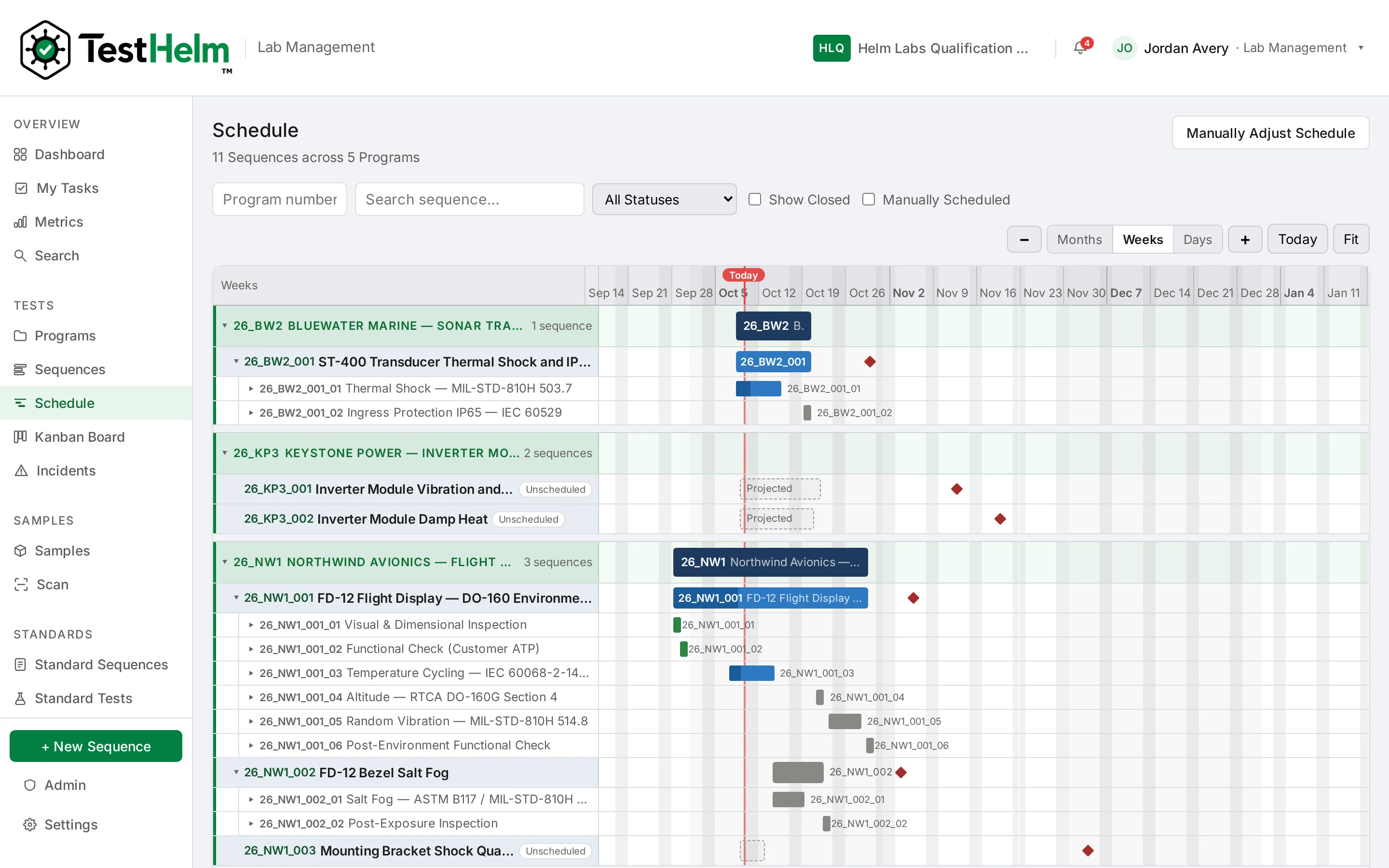
TestHelm is a laboratory information management system (LIMS) built around the test request. Every request is a sequence: from the moment it is submitted, its tests, samples, equipment and people live in one place, and the whole lab works from the same plan until the results are signed off.
Start a sequence from one of your lab’s standards or a past job, log its samples in, then add the tests it needs. Each test carries its procedure, acceptance criteria, equipment, people and a task runsheet, so whoever picks it up knows exactly what to do.
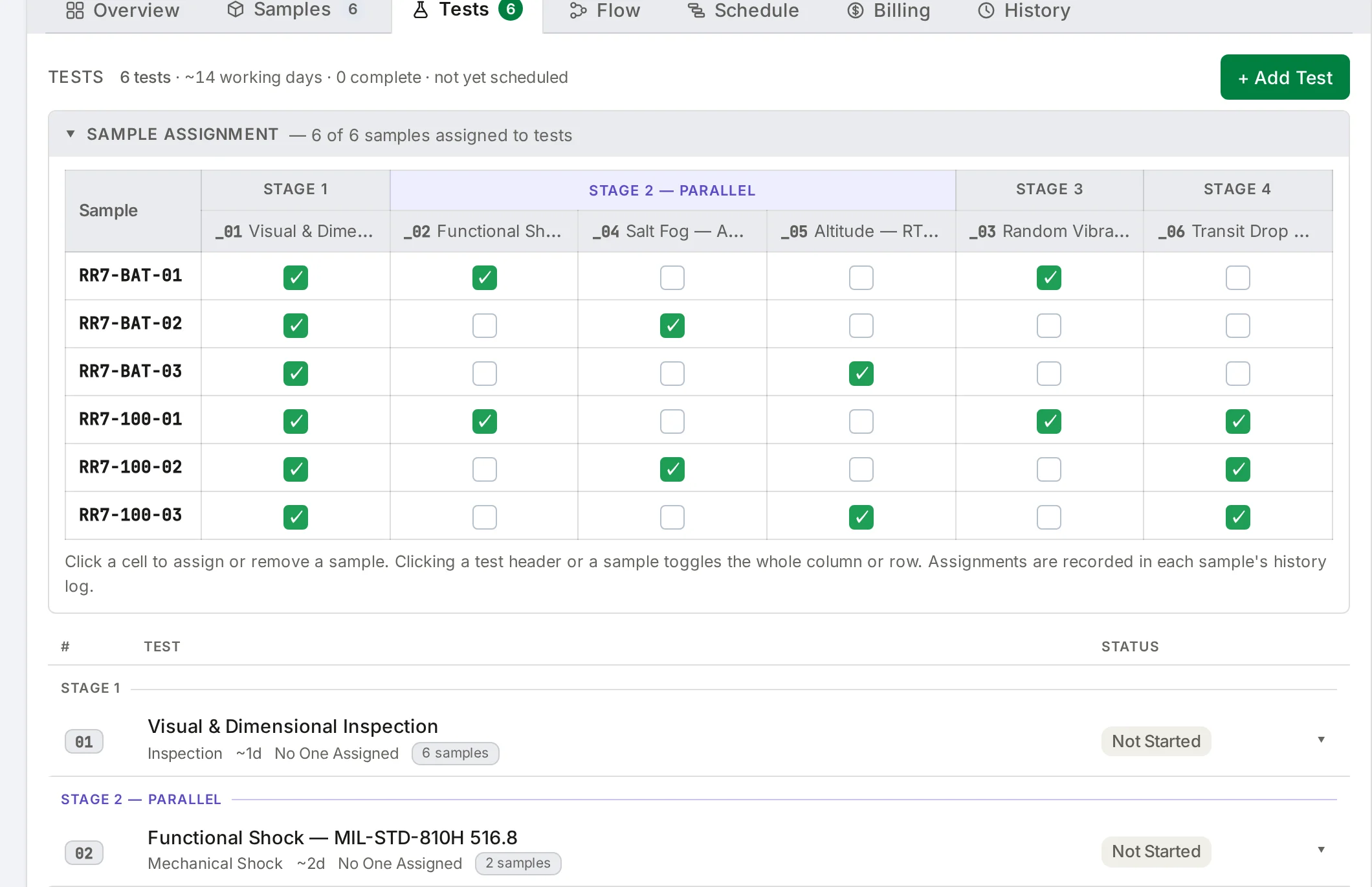
Log samples in with their serial numbers and where they were put away, or pick ones already at the lab. Each gets a lab-wide ID and a QR label. Then tick which samples go through which tests.
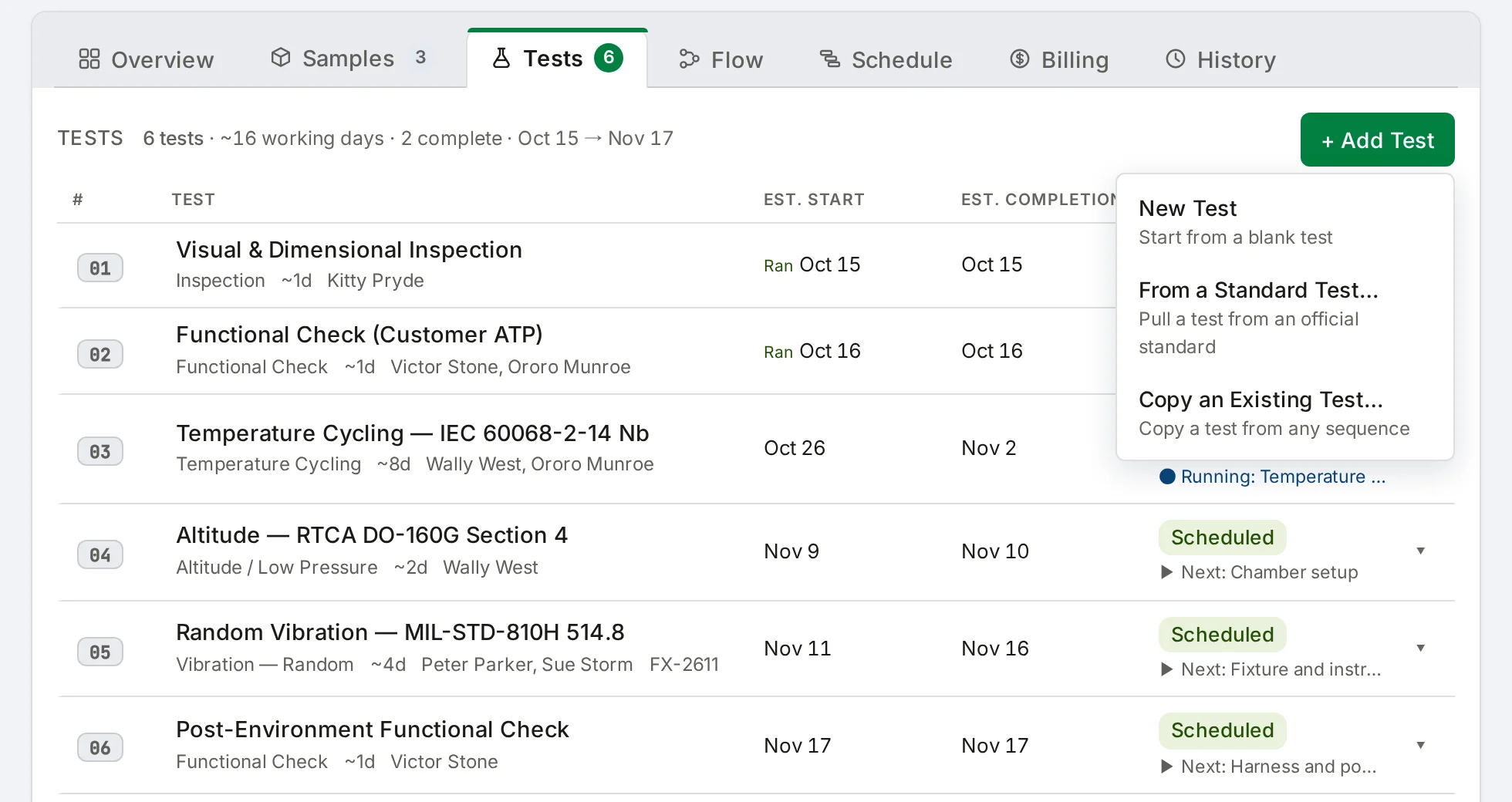
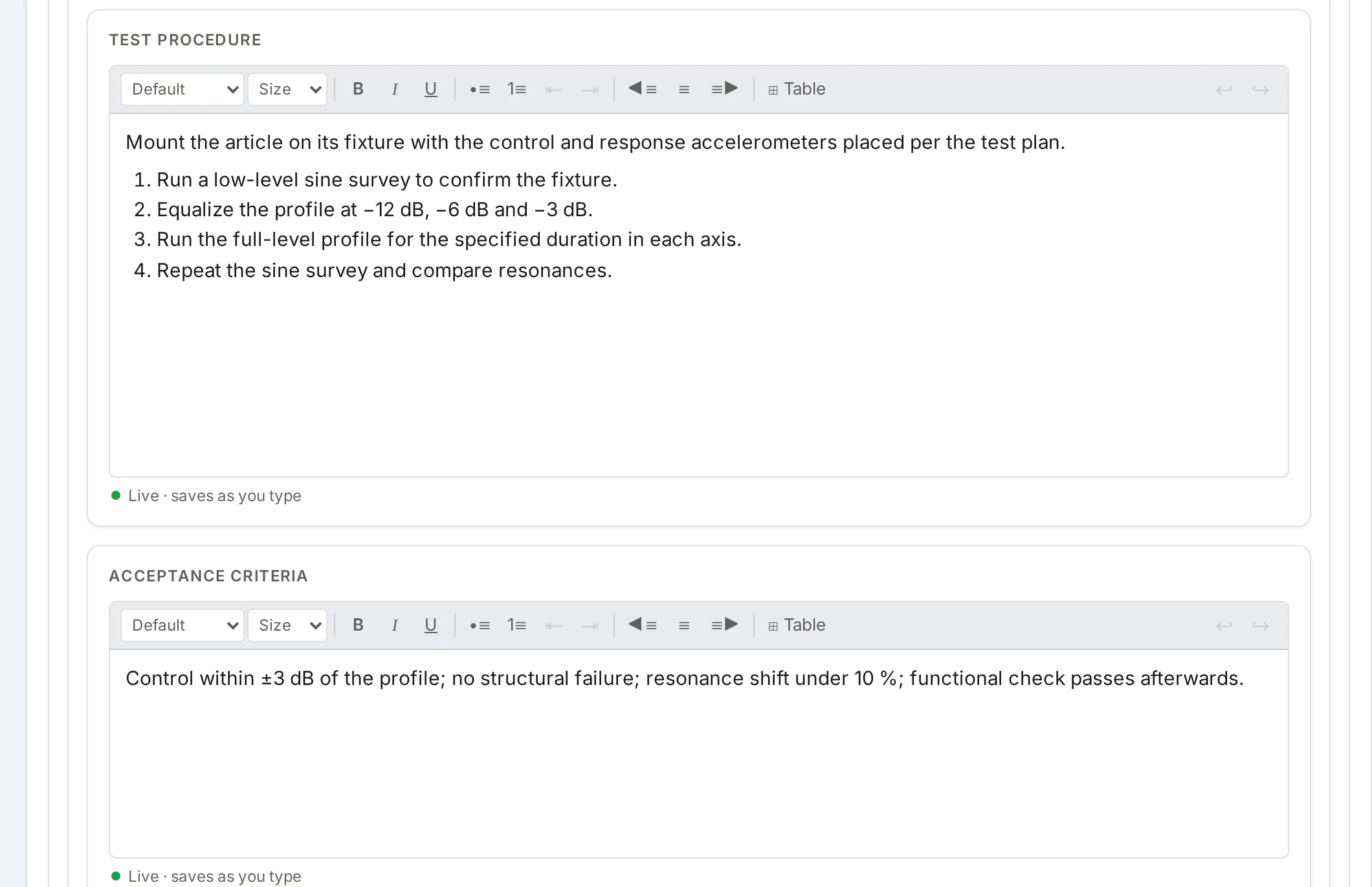
Add a test from your official standard tests, copy one from another sequence, or start a new one. Each test carries its procedure and acceptance criteria, and a task runsheet whose estimates set how long the test takes.
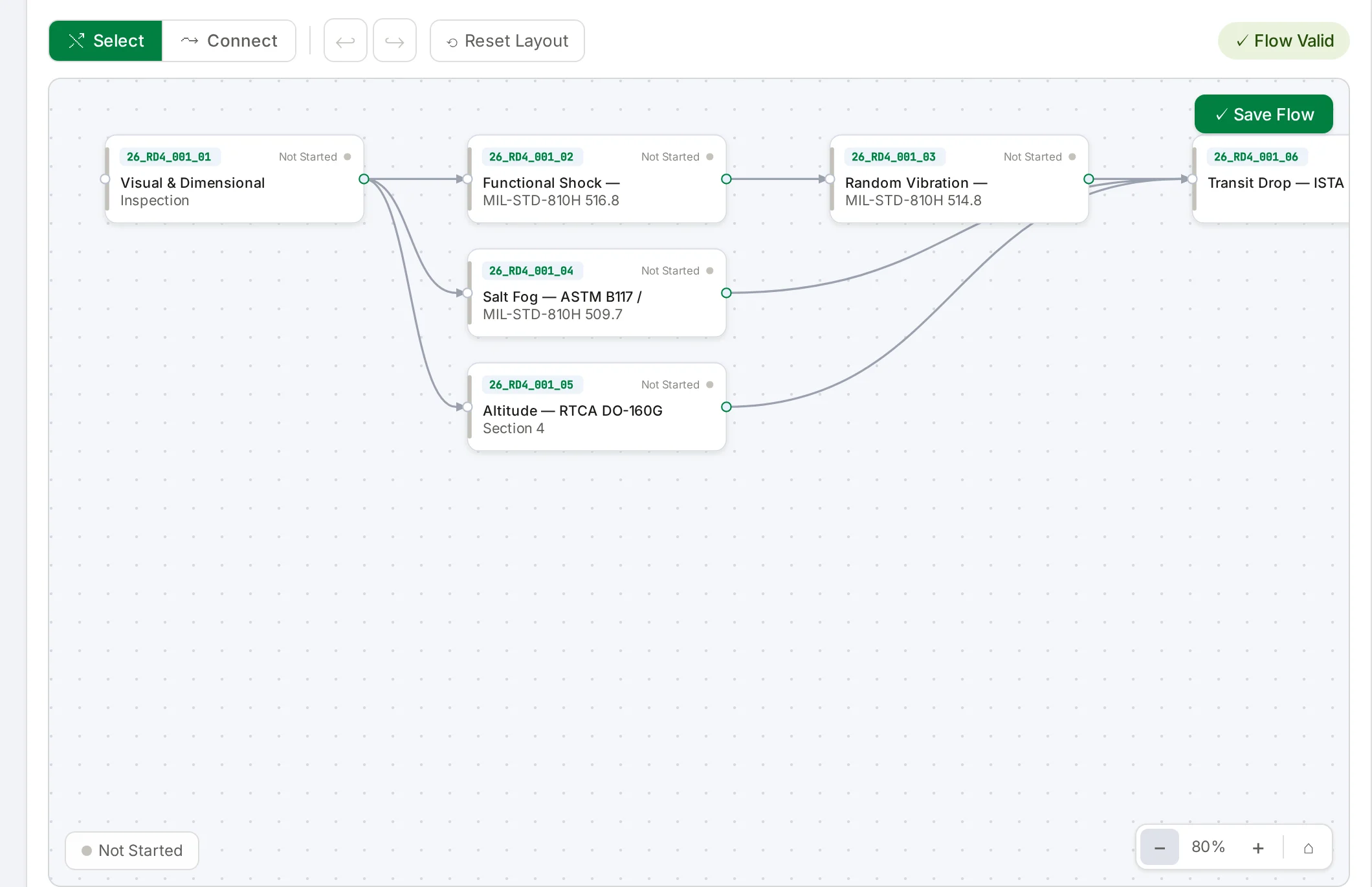
On the Flow tab, connect each test to the one that follows it. Tests with no link between them run side by side, and a test starts only once every test before it has finished.
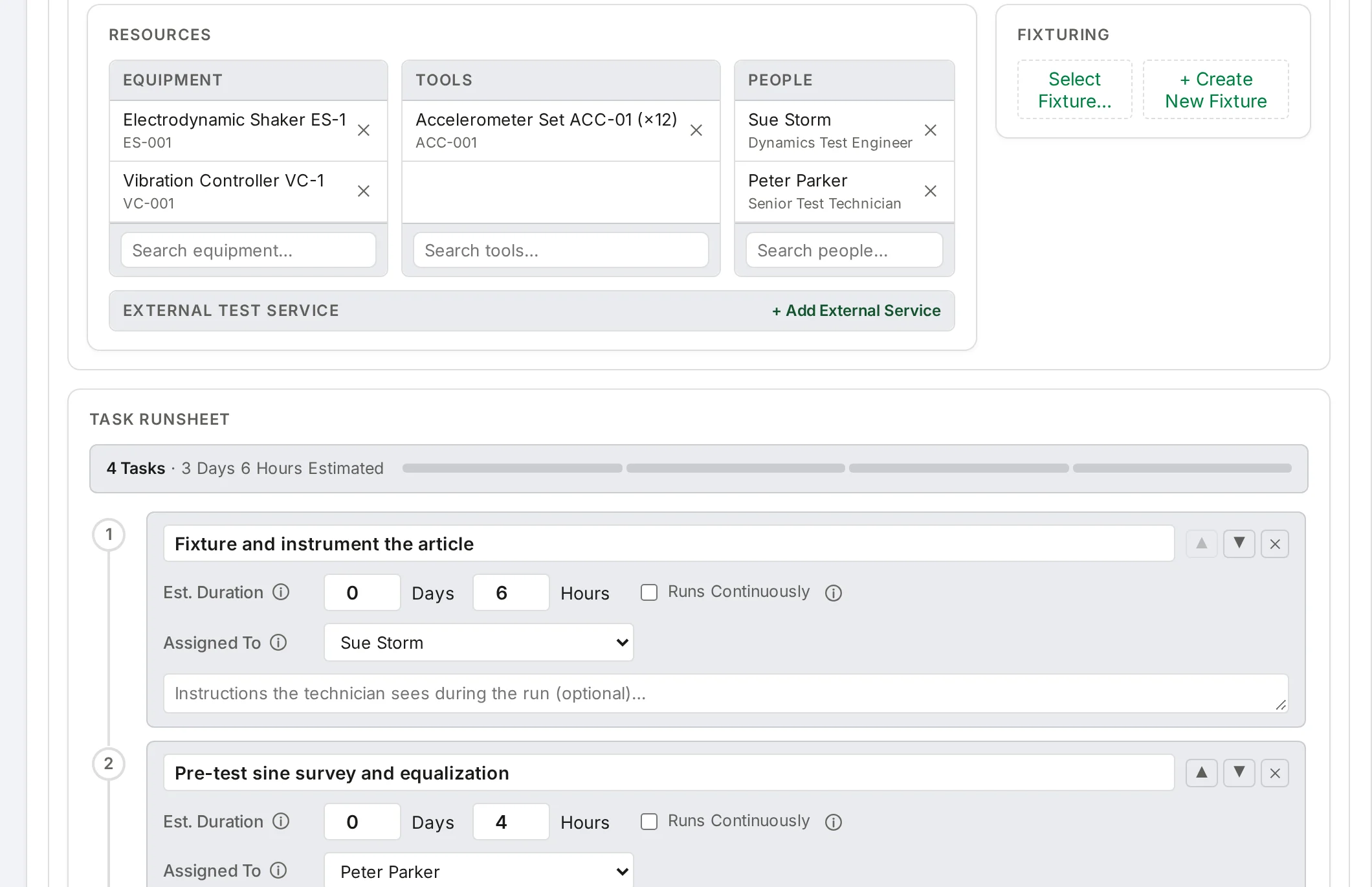
Pick the chambers, rigs, tools and people for each test. Once equipment has authorized personnel, only people with a current authorization can be put on a test that uses it.
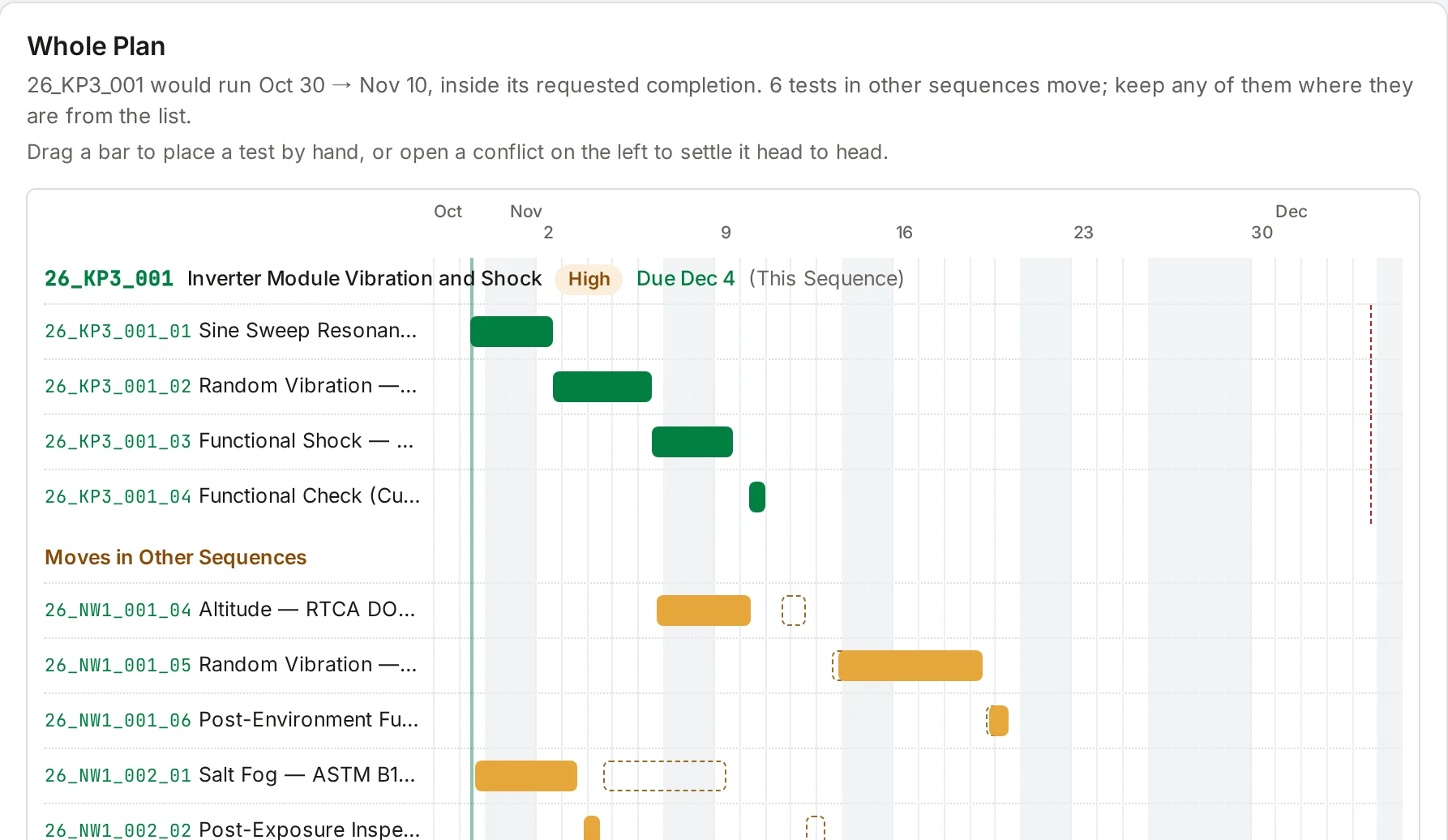
The scheduler plans the whole lab at once: every test on the equipment and people named for it, inside your working hours and holidays, around downtime and time off. You see the plan, and whether the sequence still meets its requested completion, before anything moves.
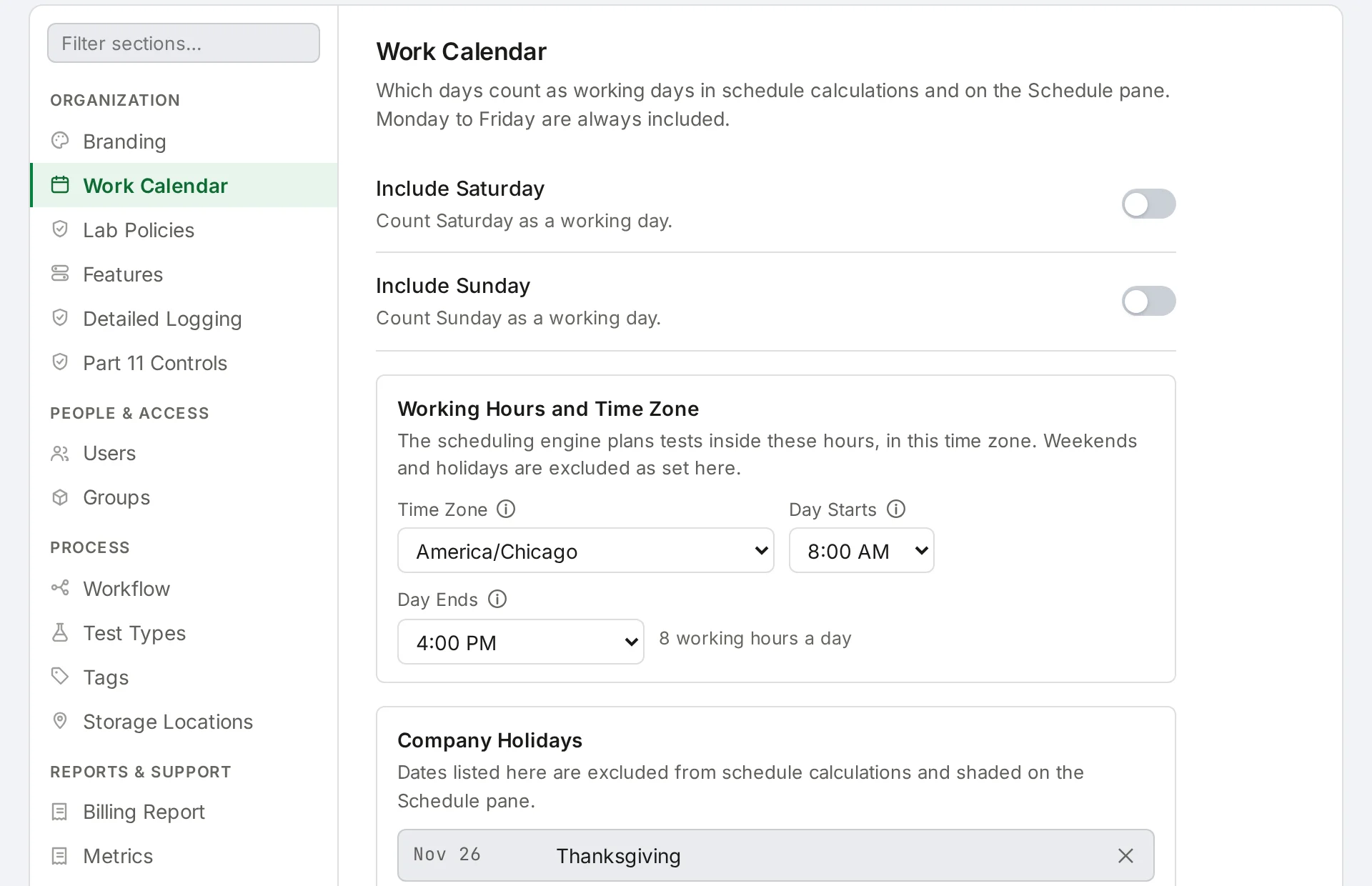
Set your working days and hours, your time zone and your company holidays once. The scheduler plans every test inside them, and around equipment downtime and people’s time off.
Run the scheduler on a sequence and it plans the whole lab at once, then shows when each test would run and whether the sequence meets its requested completion. Nothing changes until you accept.
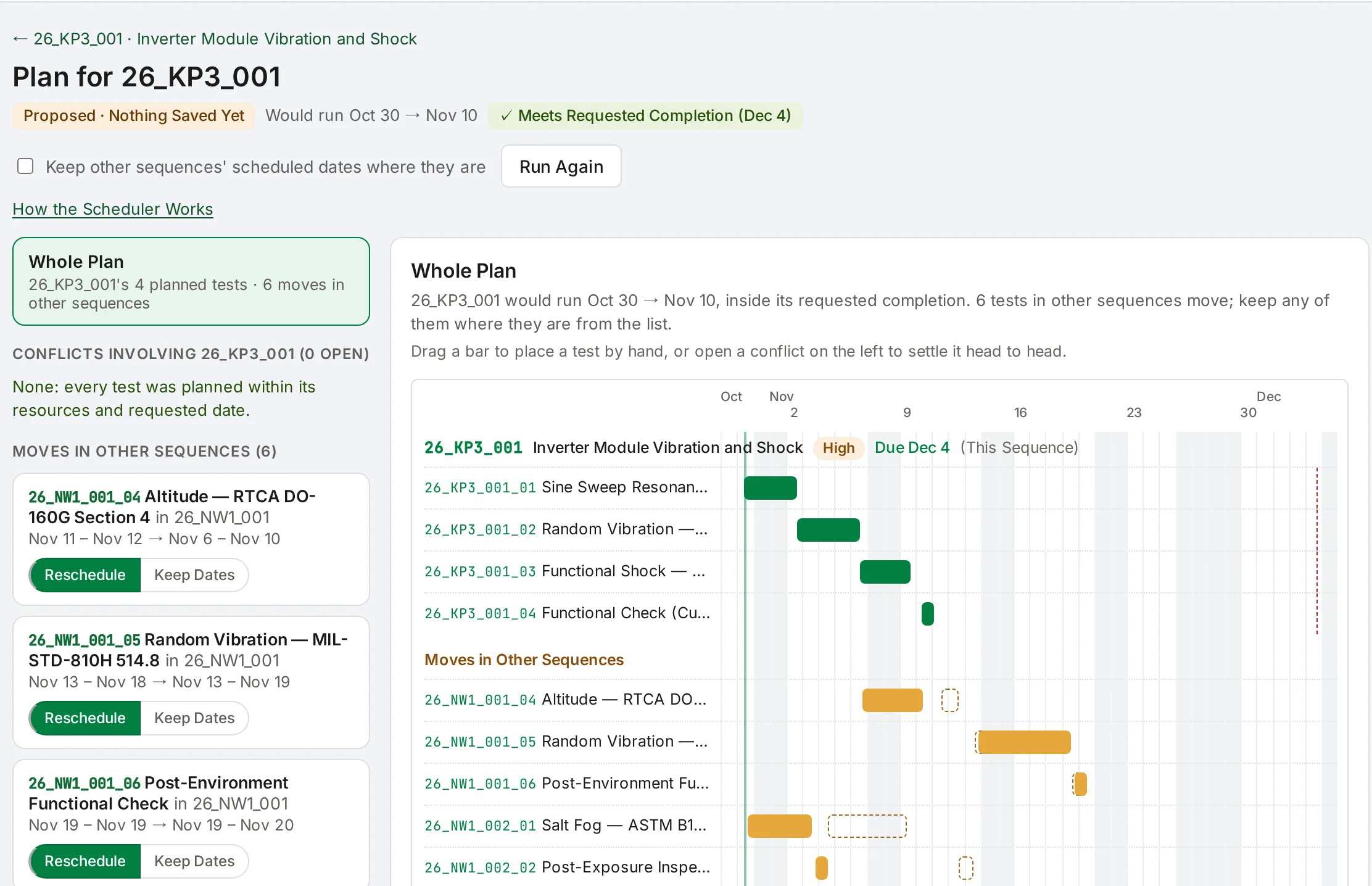
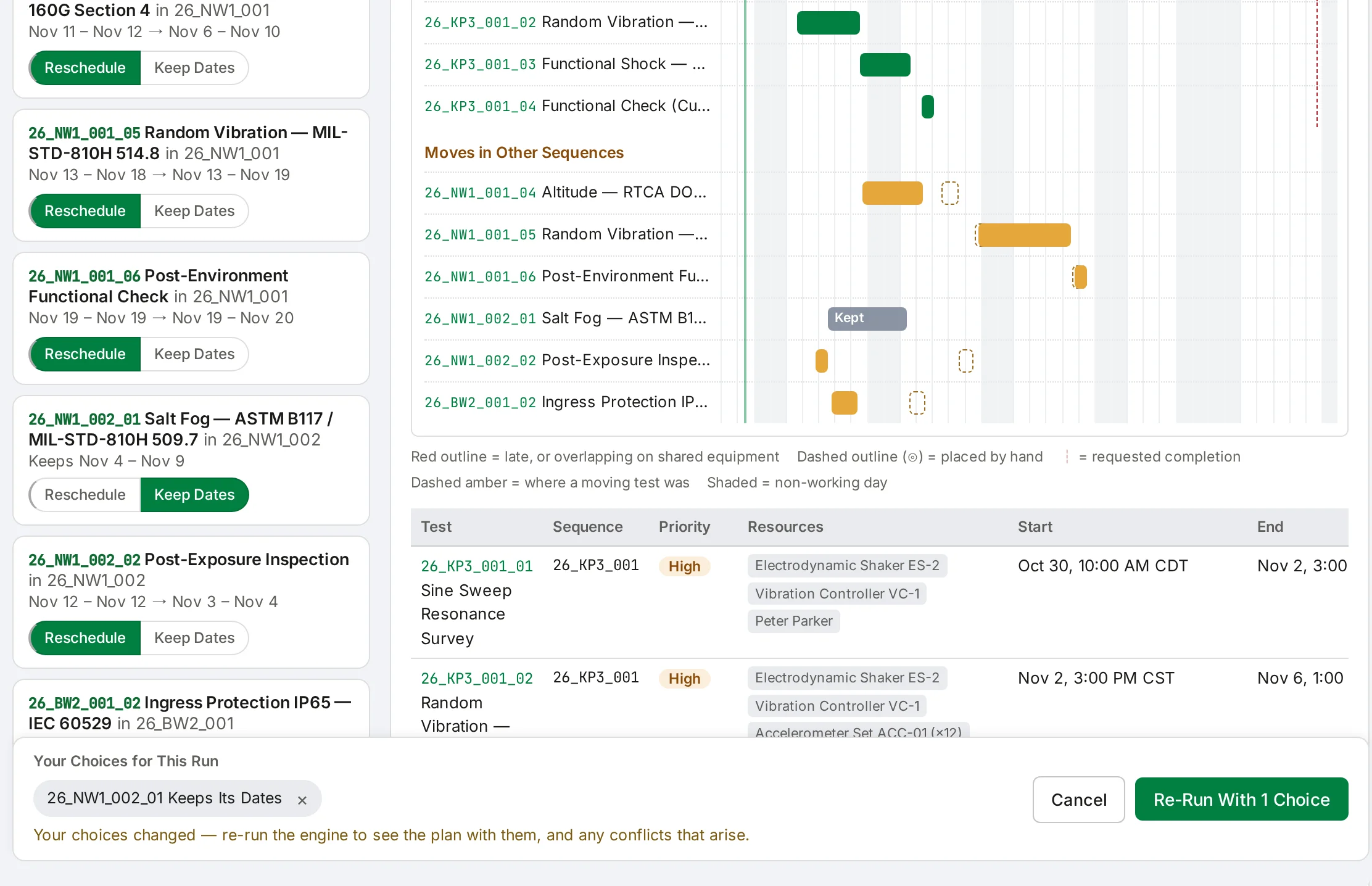
The plan lists every test in other sequences that would move to make room, with its old and new dates. Decide test by test whether each may move; kept tests stay where they are, and the scheduler runs again around them.
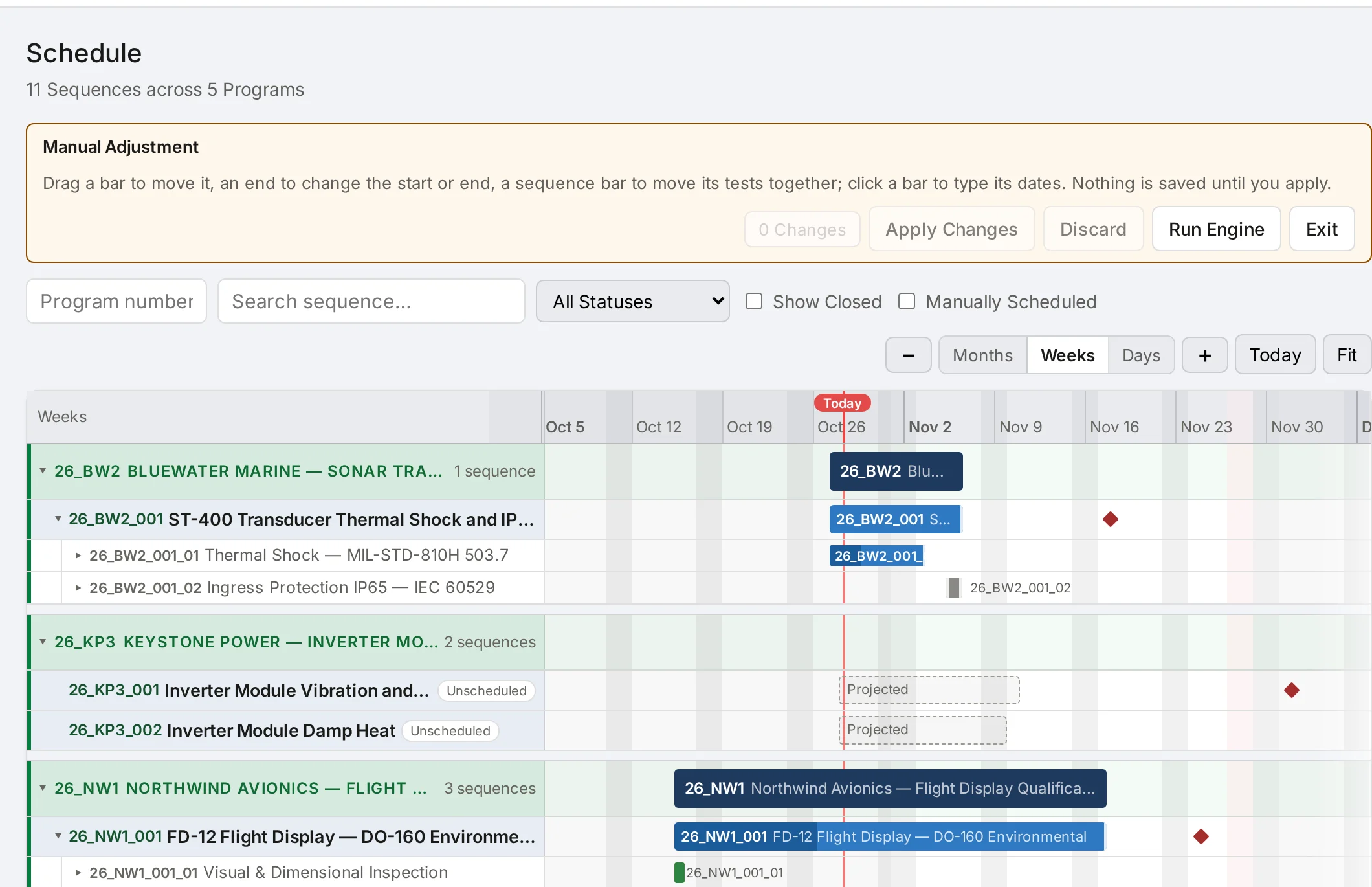
On the Schedule, drag a test’s bar to move it, drag an end to change its start or finish, or click a bar to type its dates. A test you place by hand stays put whenever the scheduler runs again.
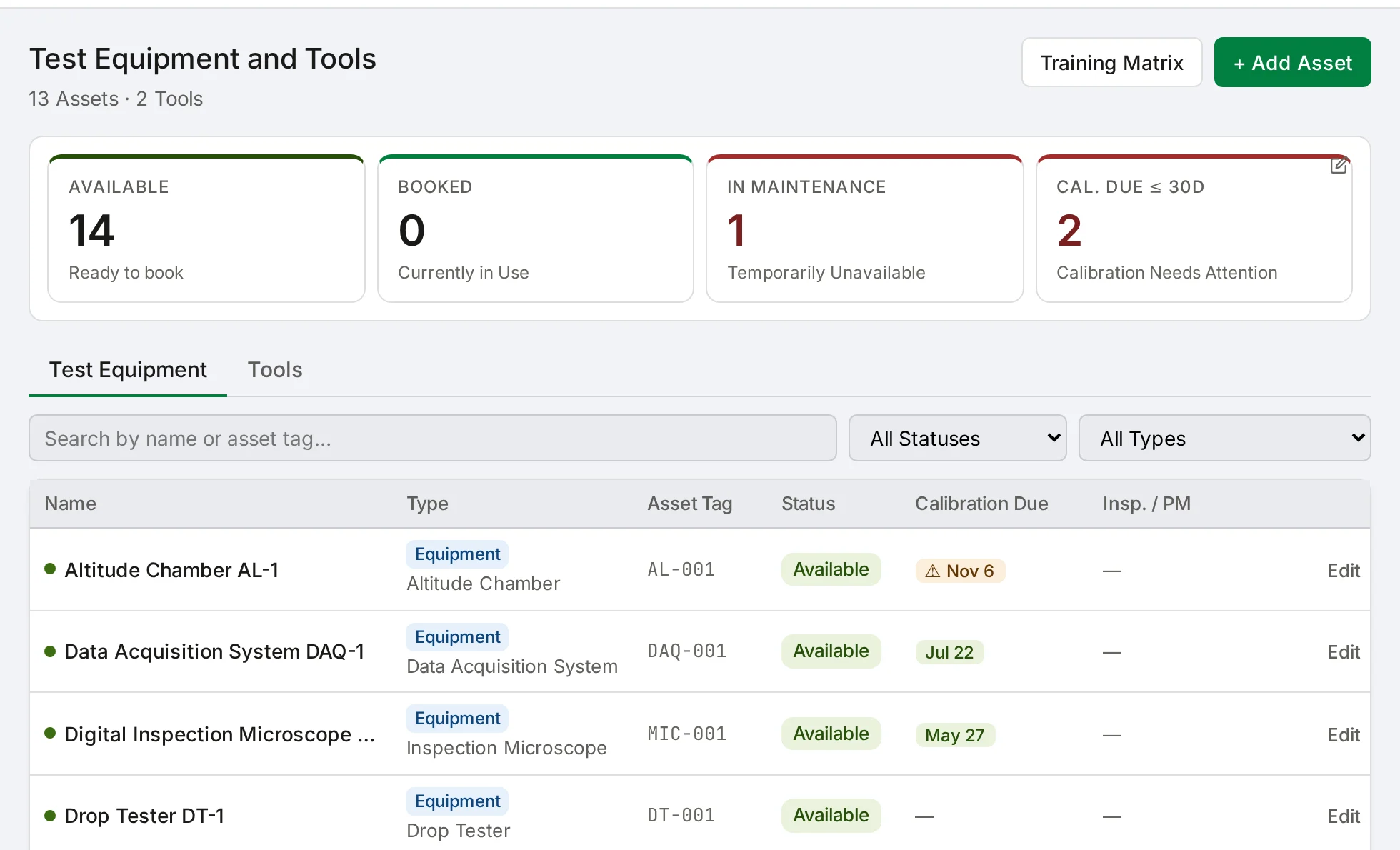
See how much of each asset’s and each person’s time is already committed in the weeks ahead, keep calibration and maintenance on schedule, and know who is trained on what. Take a rig offline or book time off, and the schedule works around it.
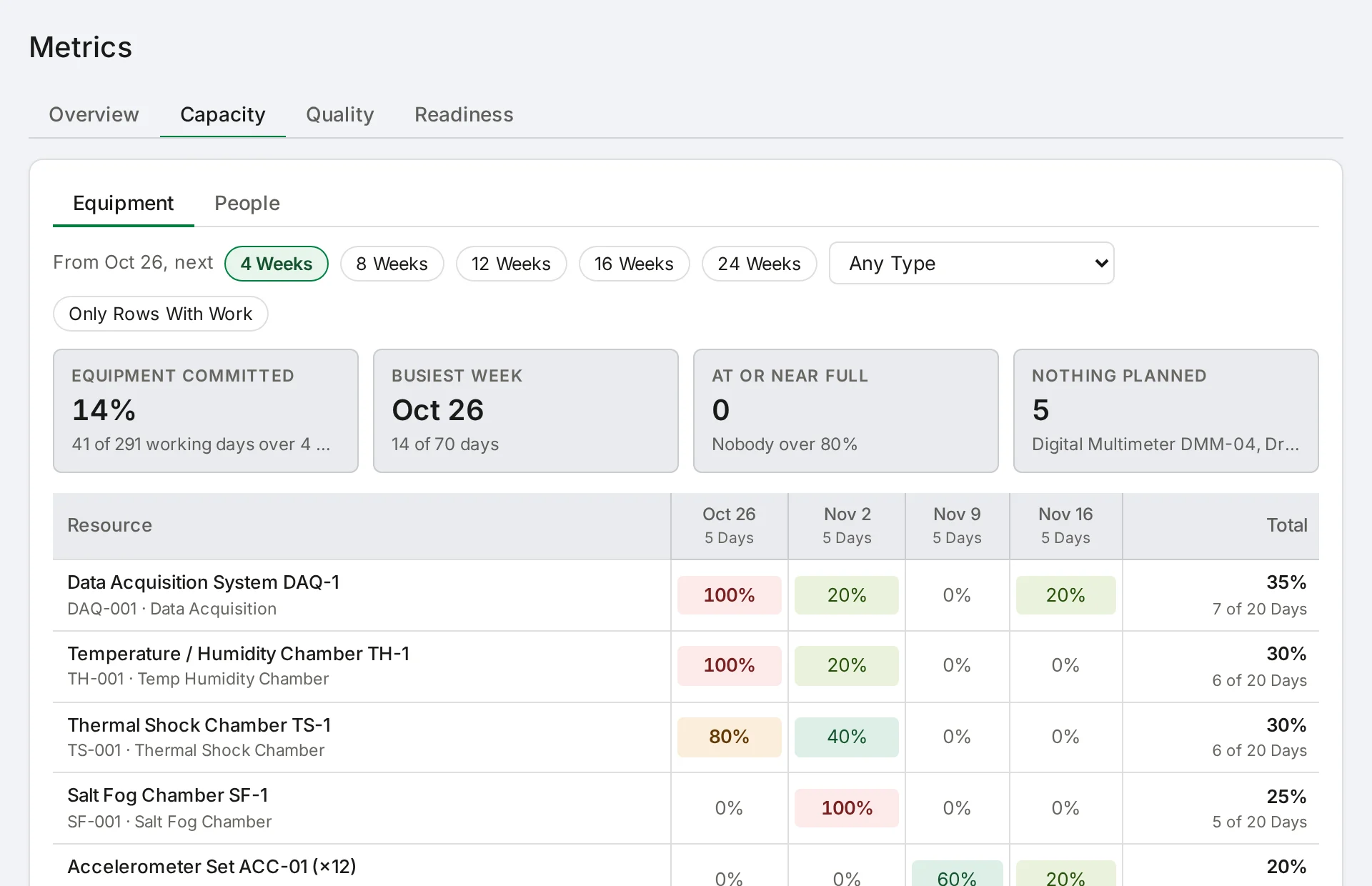
The Capacity view shows, week by week, how many of each asset’s and each person’s working days already have a test on them, from four to twenty-four weeks ahead.
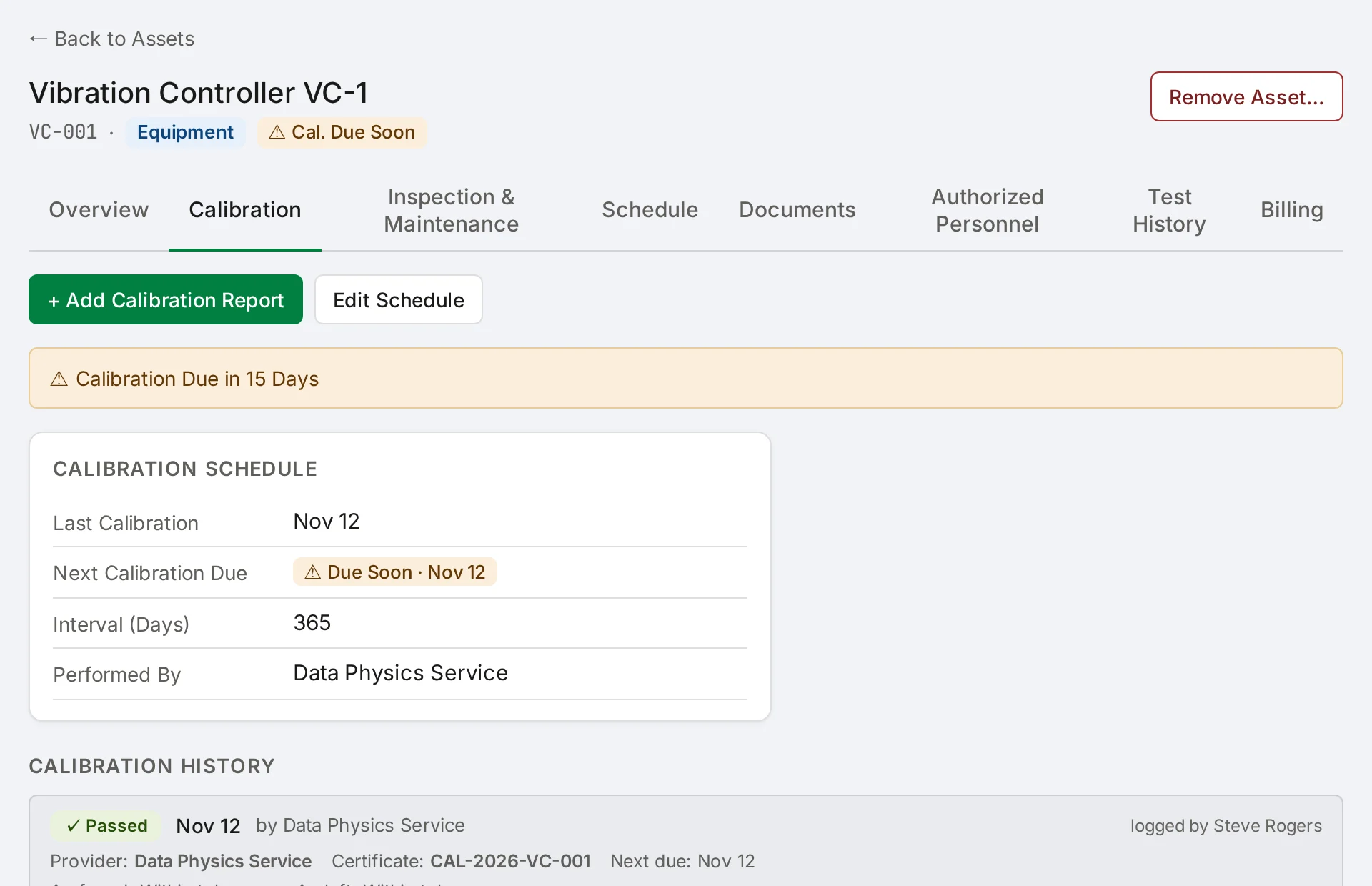
Each asset keeps its calibration interval, its last and next due dates, and a record of every calibration: who did it, the certificate number, the standard used and the as-found and as-left readings, with the report attached.
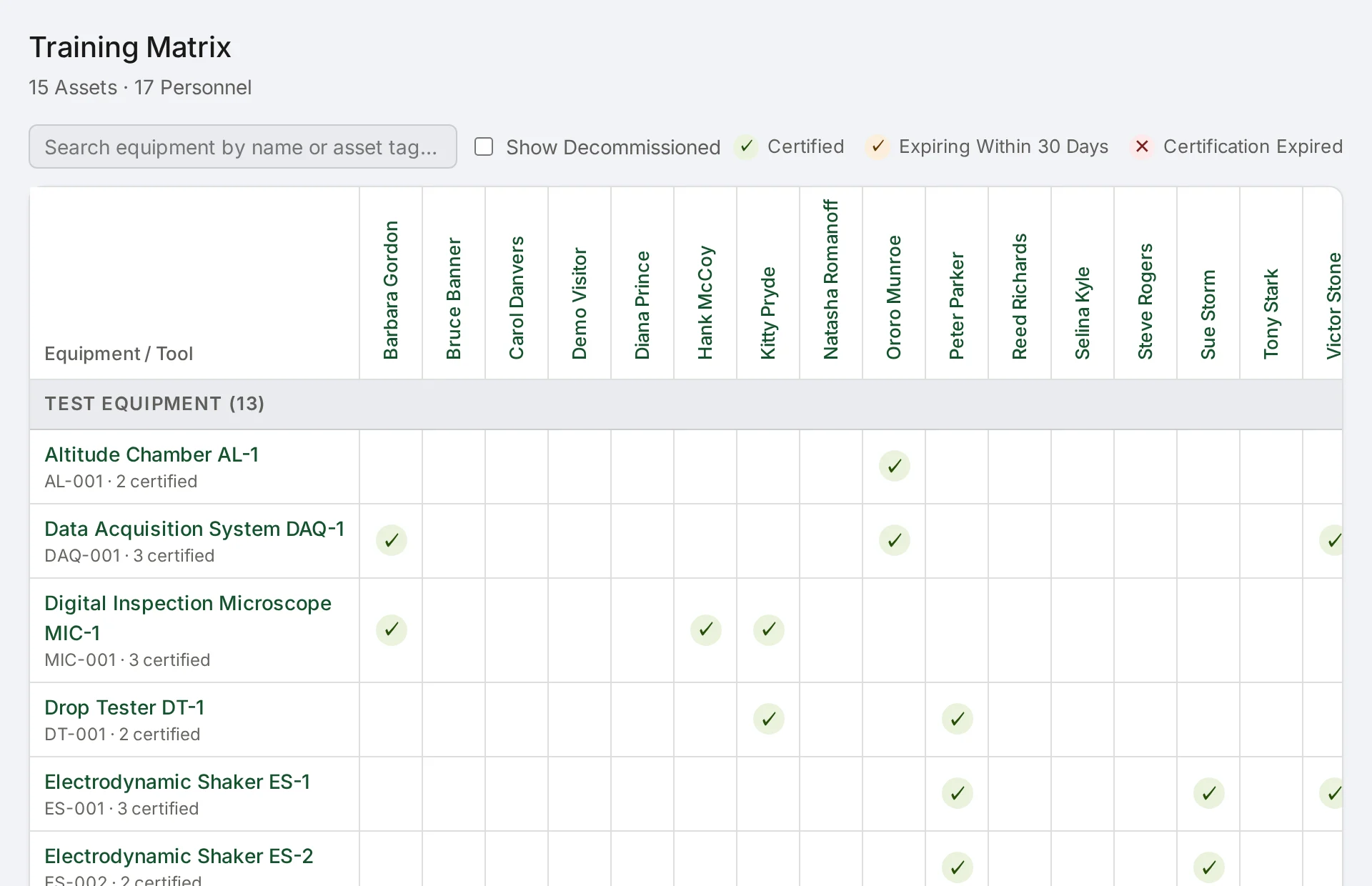
Record who is authorized on each piece of equipment, when they were certified and when it expires. A person whose authorization has lapsed can’t be put on that equipment until it is renewed.
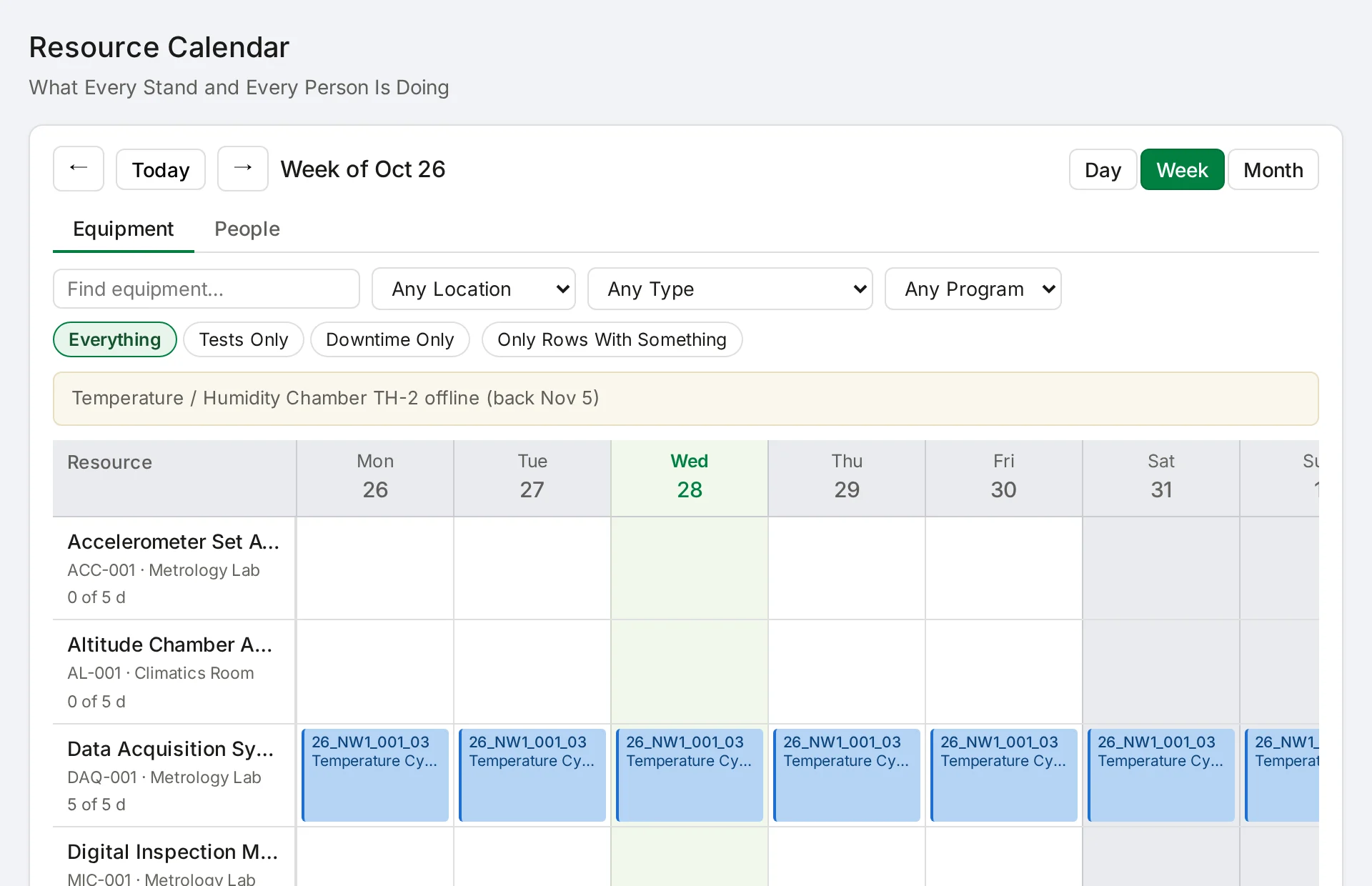
Take equipment offline for repair with its expected return, or log a person’s time off, and the scheduler keeps work off those days. The Resource Calendar shows what every stand and every person is doing.
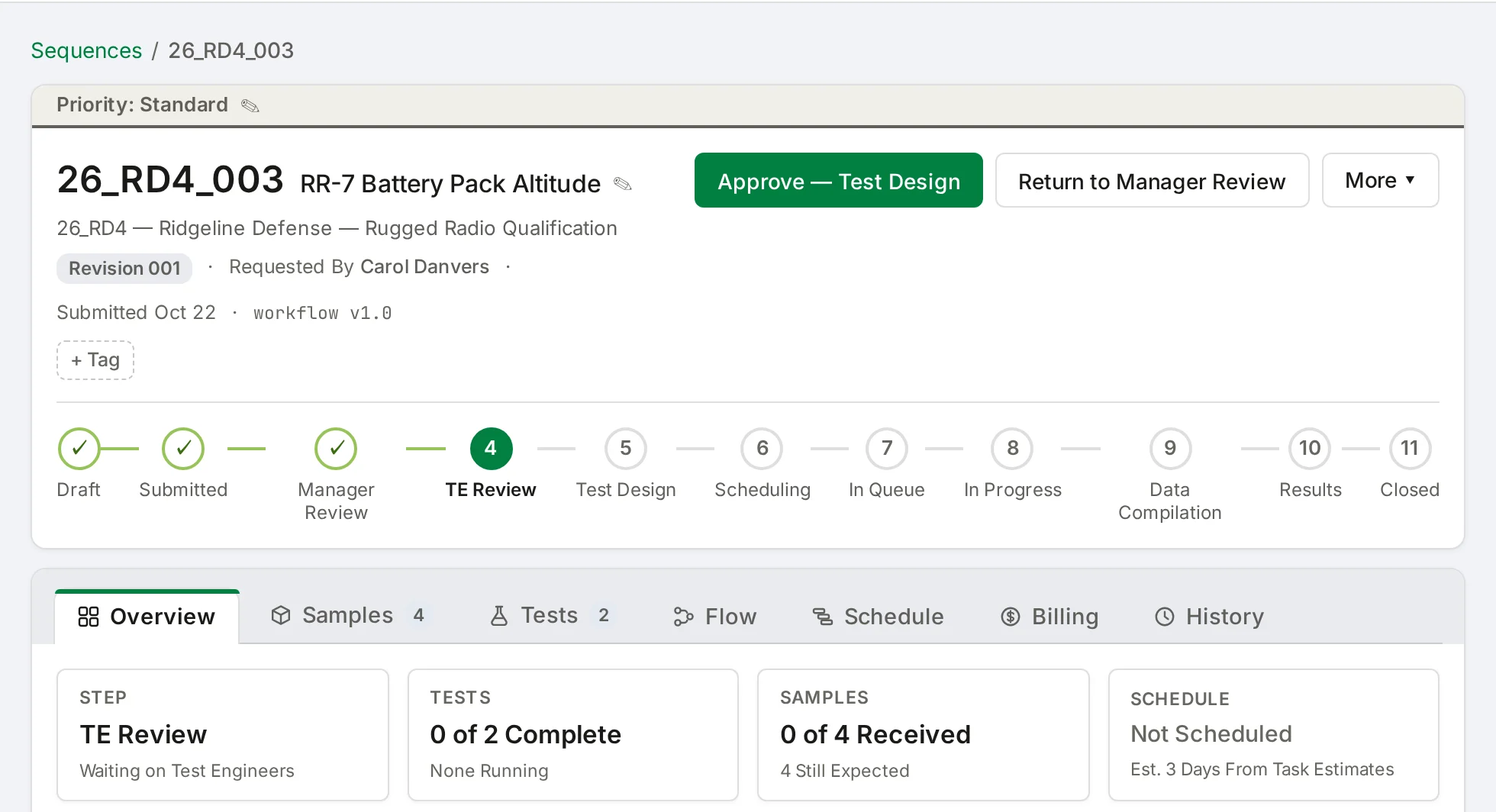
Each sequence moves through your lab’s own workflow, from submission through review, test design, scheduling and testing to results and close. Every step belongs to a group, approved parts lock, and the history shows who moved it and when.
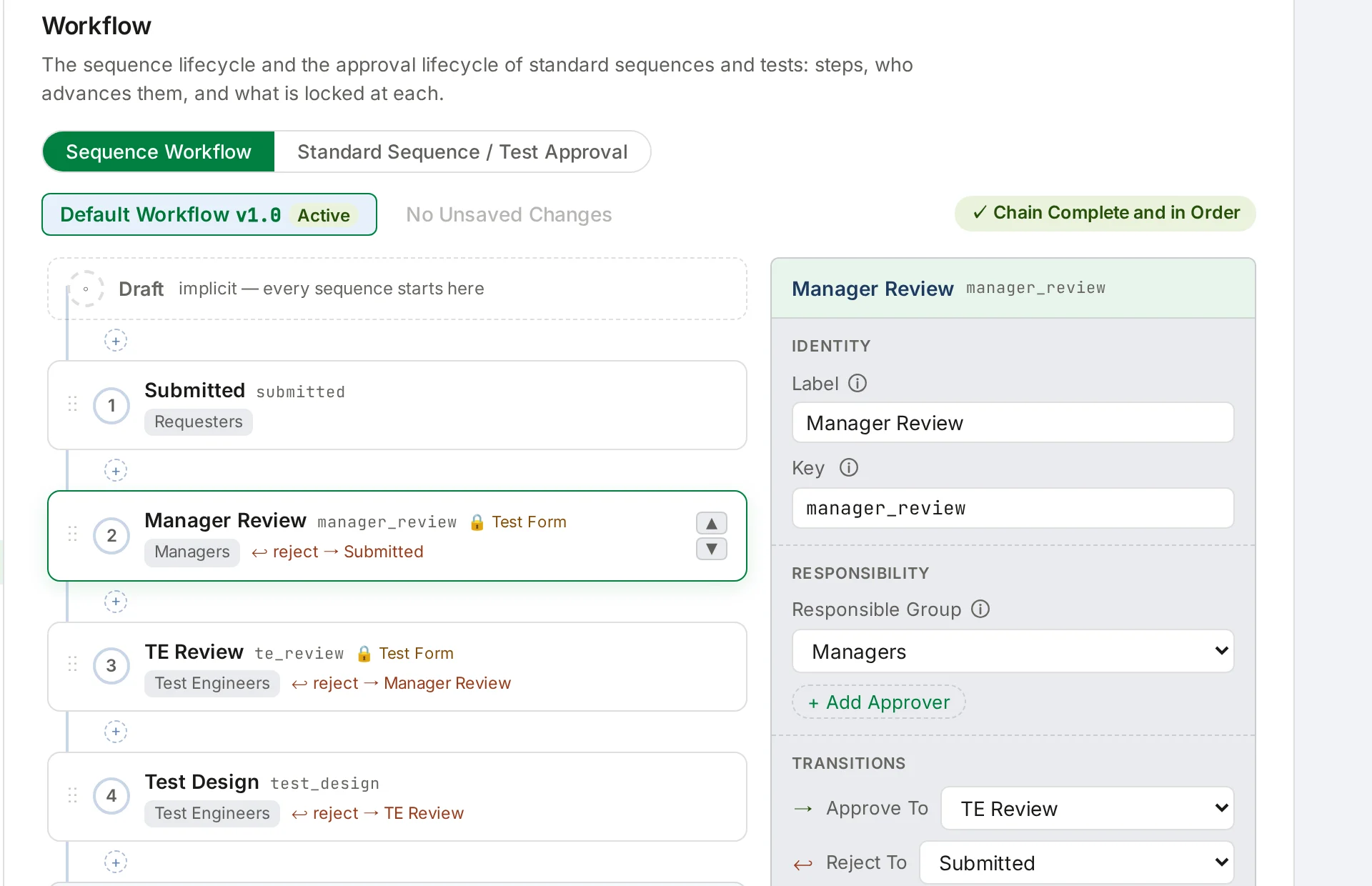
Lay out the steps every sequence moves through, from submission to close. For each step, choose the group responsible, add named approvers, say where it goes when approved or sent back, and lock what mustn’t change while it sits there.
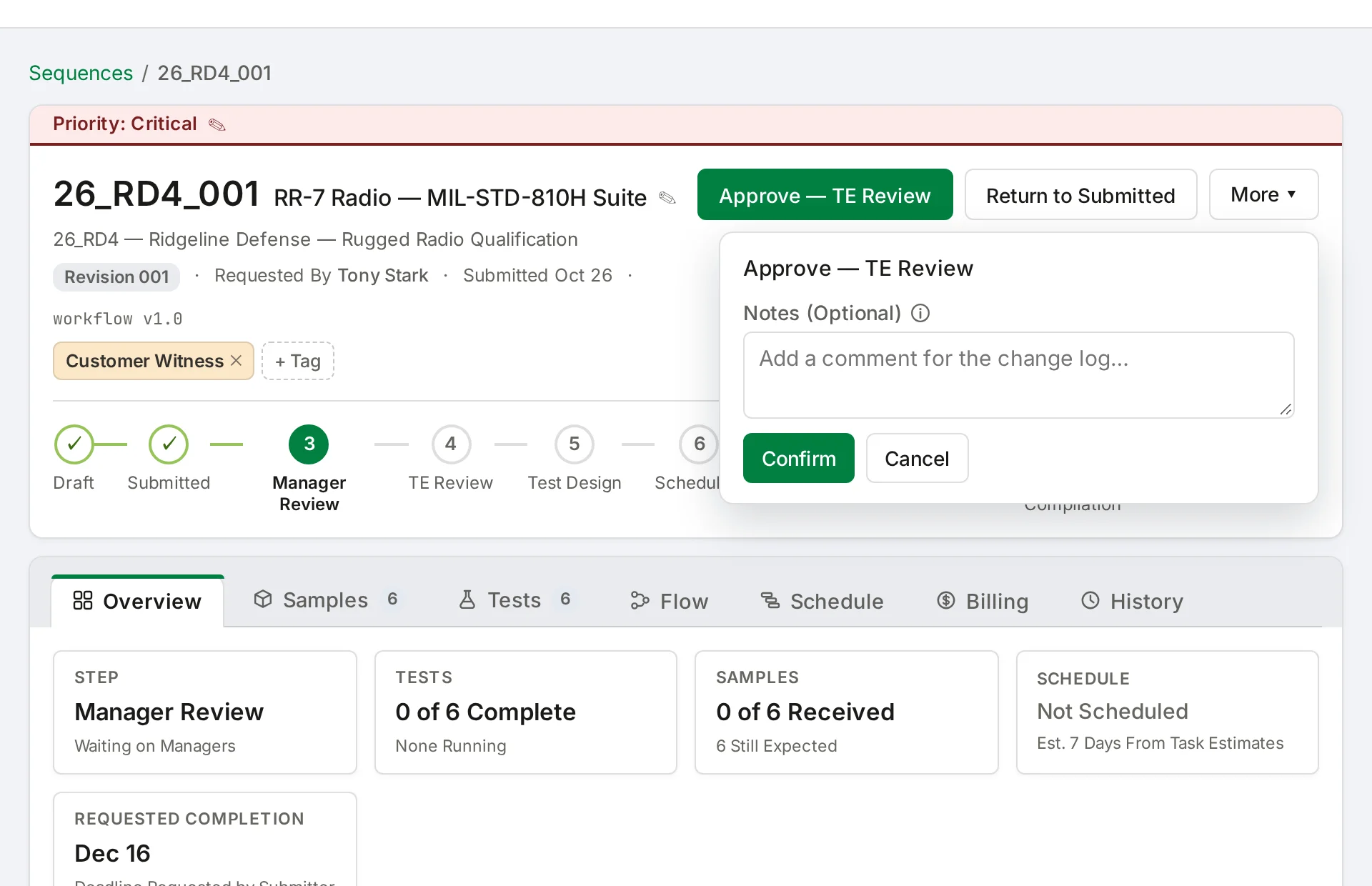
When a sequence reaches a step, the people responsible are told it is waiting on them. Only they, or an admin, can approve it on or send it back, and each move records who made it, when, and their note.
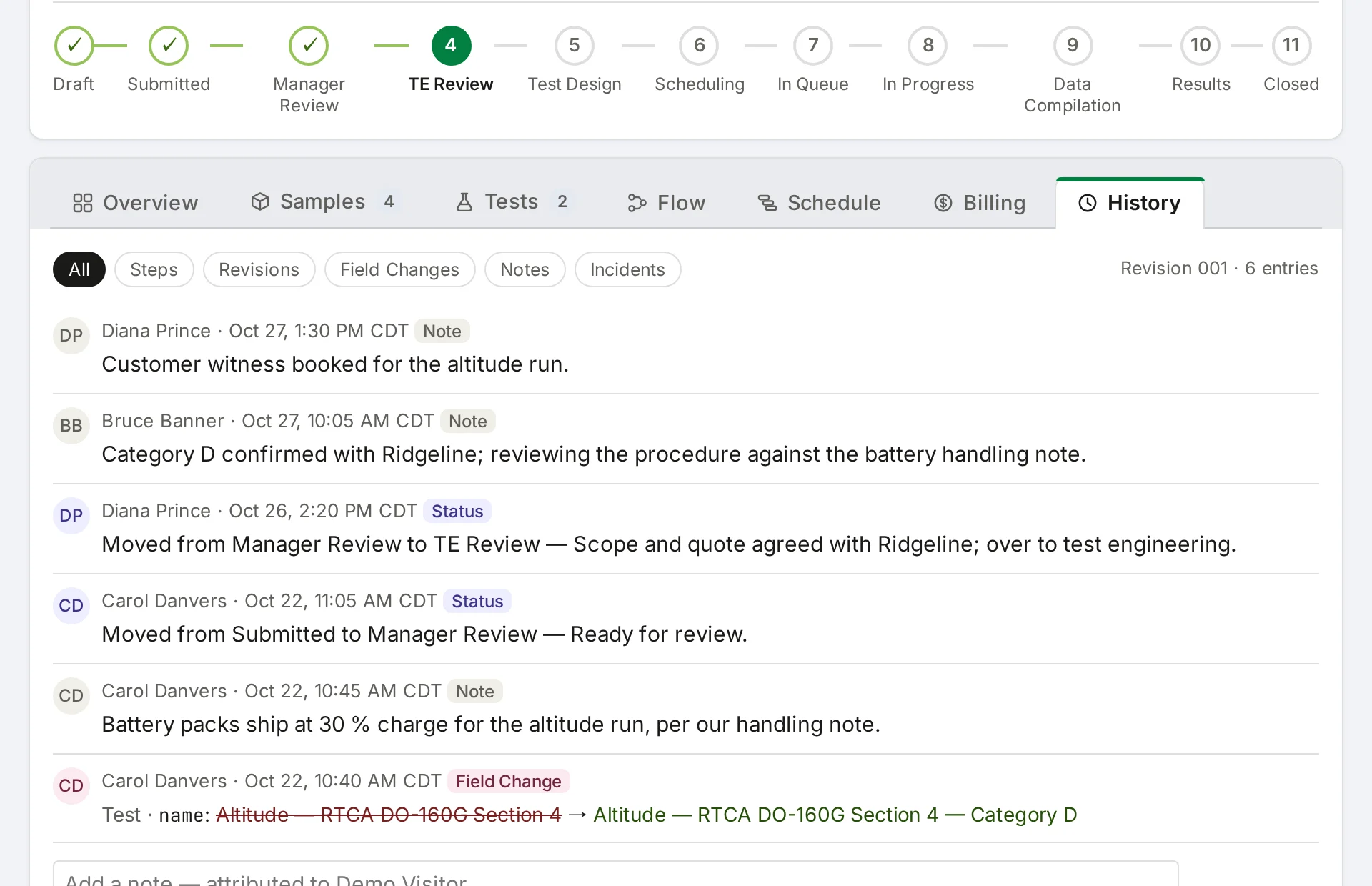
Every sequence keeps its history: each step it moved through and who moved it, notes, incidents, and revisions with their reasons. Turn on detailed logging and every field change is kept too, with its old and new value.
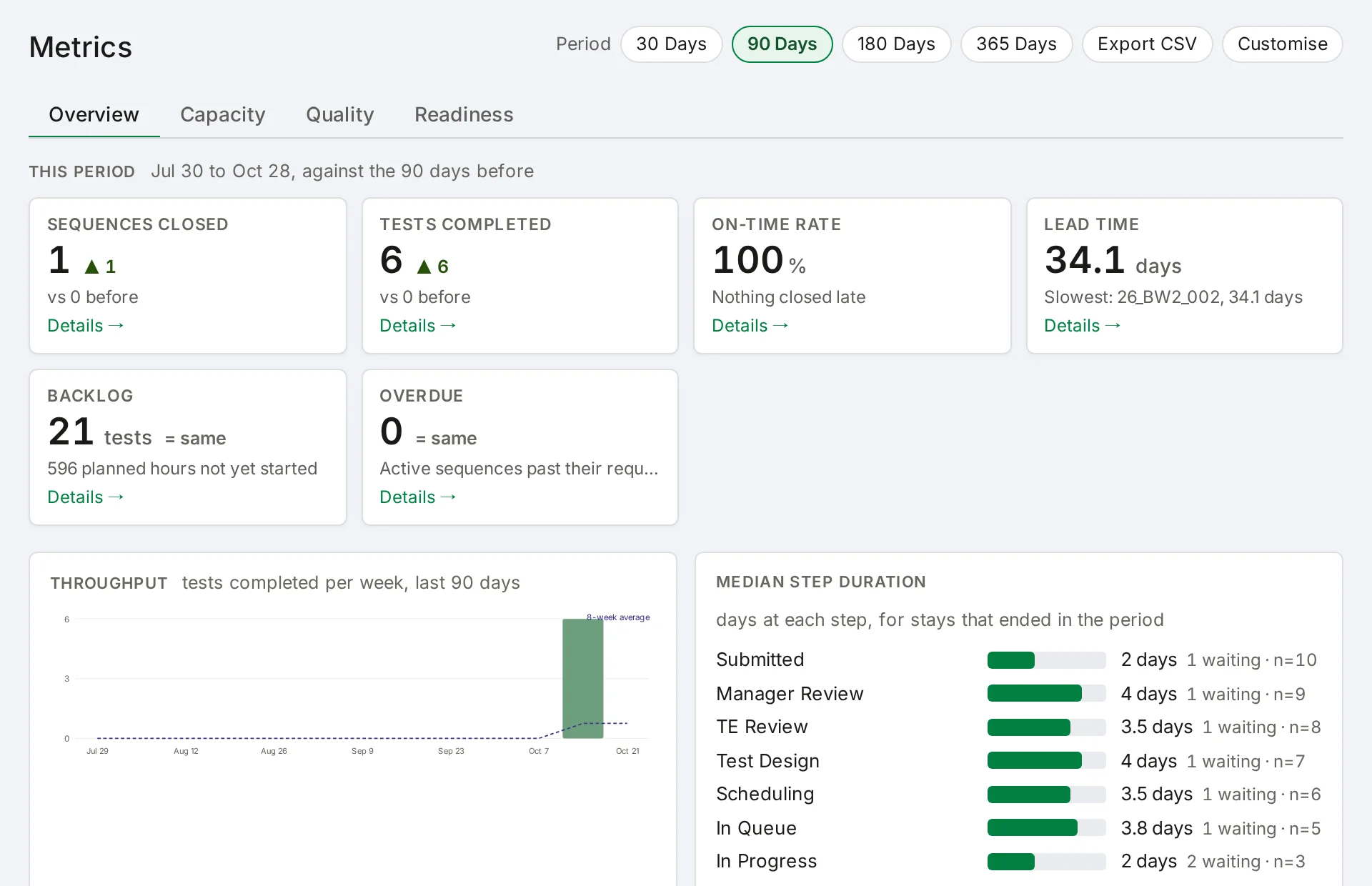
Download a summary PDF of a closed sequence or test, with its procedures, acceptance criteria, results, resources and tasks, or file it with the sequence’s attachments. The Metrics page tracks throughput, on-time rate, lead time and quality across the lab.
Assessors ask for the same evidence again and again: who did the work and whether they were authorized, which equipment was used and whether it was in calibration, where each sample went, and what changed and why. TestHelm keeps that record as the work happens. Here is what it keeps for each requirement: for ISO/IEC 17025 and ISO 9001, and for the medical, automotive and aerospace standards, ISO 13485, IATF 16949 and AS9100.
For labs accredited to ISO/IEC 17025, or working toward it.
The Training Matrix shows who is authorized on each piece of equipment, since when and until when. A lapsed authorization keeps that person off the equipment, and other certifications are kept with their certificates.
Calibration, inspection and maintenance due dates on every asset, flagged as they come due. Equipment that is offline or out of calibration is flagged on the tests that use it.
Each calibration records the reference standard it was traceable to, its measurement uncertainty, the certificate number and who performed it, with the report attached.
Outside labs kept as approved, conditional or disqualified, with their accreditations, when they were last evaluated and their documents. A disqualified provider isn’t offered for outsourced tests.
Each request goes through the review steps you set, with named approvers, and every approval or send-back records who made it, when, and their note.
Standard tests hold your methods: the procedure, acceptance criteria and spec references. A revision can’t be peer-reviewed or approved by its own author.
A lab-wide ID and QR label on every sample, its condition on arrival with any deviation and when the customer was told, every move and custodian, and a disposition with who authorized it.
Who started and completed each task, and when, the equipment and people on each test, and a pass, fail or inconclusive for each sample. Detailed logging keeps every field change, old value and new.
An incident stops a test and quarantines the samples it names, and the decision to resume, retest or cancel is kept with its reason. After a failed calibration, each test since the last pass is reviewed: Results Stand, Retest Needed or Customer Told.
Standard-test revisions keep their reasons, and an approved revision can’t be changed: a change opens a new one. Workflow locks keep the approved parts of a sequence as they are.
Every step, revision, note and incident stays in the history with who and when, and history entries can’t be edited. Each lab’s data is kept in a database of its own.
Each incident’s root cause, and corrective actions with an owner, a due date and a status that ends in verification, which only a manager or quality can mark.
The Metrics page tracks throughput, on-time rate, lead time, first-pass yield, incidents and time to disposition, and counts the calibrations and authorizations coming due.
For in-house labs within their company’s ISO 9001 quality system, and labs certified to it themselves.
Calibration due dates, certificates and the standard each was traceable to. A failed calibration lists every test run on that equipment since its last pass, so you can decide whether those results still stand.
The Training Matrix shows who is authorized on what and when it expires, with each person’s other certifications and their certificates on file.
Standard tests revised with their reasons and approved by someone other than the author, and a history of every change whose entries can’t be edited.
Each request passes through the review steps you set, and every decision is recorded with who made it, when, and their note.
Approved, conditional and disqualified outside labs, with their accreditations, evaluation dates and documents. Disqualified ones aren’t offered for outsourced tests.
Each test carries its procedure, acceptance criteria and task runsheet. Only people with a current authorization go on equipment, and out-of-calibration equipment is flagged.
Every sample has a lab-wide ID and a QR label, and its history traces each move, custodian and test through to its disposition.
Customers’ samples are logged with their condition on arrival, held by a named custodian, and returned with who authorized it and the carrier and tracking number.
Each sequence moves through your approval steps to close, and every approval records who made it and when.
An incident stops the test and quarantines the samples involved, and the decision to resume, retest or cancel is kept with its reason.
On-time rate, lead time, first-pass yield, incidents and time to disposition on the Metrics page, with CSV exports.
Root cause and corrective actions on each incident, with owners, due dates and verification by a manager or quality.
For labs that test medical devices and their packaging under an ISO 13485 quality system.
Standard tests keep each revision with its reason, approved by someone other than its author. An approved revision can’t be changed: a change opens a new one.
History entries can’t be edited, and with detailed logging on, every change to a record stays identifiable, with its old and new value, who made it and when.
Each person’s skills and certifications on file with their certificates, and the Training Matrix of who is authorized on which equipment, and until when.
Each request passes through the review steps you set, with named approvers, and every decision is recorded with who made it, when, and their note.
Outside labs kept as approved, conditional or disqualified, with when they were last evaluated, their accreditations and their documents. Disqualified ones aren’t offered for outsourced tests.
Every sample has a lab-wide ID and a QR label, and shows its status: expected, in the lab, in test, quarantined, awaiting disposition or dispositioned.
Each sample’s history records every move, custodian and test, in order, through to its disposition.
Customers’ samples are logged with their condition on arrival, held by a named custodian, and returned with who authorized it and the carrier and tracking number.
Calibration intervals, certificates and the standard each was traceable to. After a failed calibration, every test run on that equipment since its last pass is reviewed and the outcome recorded.
An incident stops the test and quarantines the samples it names, and the decision to resume, retest or cancel is recorded with who made it and why.
The Metrics page tracks on-time rate, lead time, first-pass yield, incidents and time to disposition, with CSV exports.
Each incident’s root cause, and corrective actions with an owner, a due date and verification by a manager or quality.
For automotive labs and suppliers. IATF 16949 is used together with ISO 9001, so the ISO 9001 list applies too; these are the automotive requirements on top of it.
Each calibration’s as-found and as-left readings and its pass or fail. After a failure, every test run on that equipment since its last pass is reviewed, and Customer Told is one of the outcomes.
Your standard tests set out the lab’s scope: each test’s procedure and the specs it follows, such as ASTM or ISO, alongside who is authorized on its equipment and the record of every run.
Each test an outside lab runs for you can carry the accreditation that covers it, such as a scope item on their ISO/IEC 17025 certificate, with its expiry date.
The Training Matrix shows who is certified, expiring or expired on each piece of equipment, so a training need shows before an authorization lapses.
Each sample’s lab-wide ID and QR label tie it to every test it went through, its results and its disposition.
Each test is kept with its procedure, equipment, people and a result for every sample, with a summary PDF of each closed sequence and a CSV of its samples for customer review.
Samples named in an incident go into quarantine until someone decides what happens to them, and a failed calibration lists the tests whose results need a second look.
An incident carries the containment (the test paused, its samples quarantined), the root cause, and corrective actions through to verification.
For aerospace and defense labs. AS9100 includes all of ISO 9001, so the ISO 9001 list applies too; these are the requirements it adds.
The equipment list is your register of measuring equipment: type, asset tag, location and calibration interval, flagged as calibration comes due and on any test that uses it.
Outside labs kept as approved, conditional or disqualified, with the tests each one runs for you and the accreditation that covers each.
Test equipment and tools on record, with inspections and preventive maintenance scheduled and logged, and downtime kept off the schedule.
A sequential record for each sample: every move, custodian and test, in order, from arrival to disposition.
Who may decide what happens after an incident is set by role, the samples involved stay quarantined until then, and each decision is kept with who made it and why.
On-time rate against each request’s requested completion, and first-pass yield, on the Metrics page: data for two of the measures AS9100 names, on-time delivery and conformity.
TestHelm keeps the records these clauses ask for; accreditation or certification still comes from your own quality system and your assessment body.
Create a free demo account, pick your industry, and step into a working TestHelm lab: people, equipment, standard tests, samples and sequences at every stage of the workflow. It is yours alone for a day, and guided walkthroughs show you around.
Automotive, aerospace, materials, chemistry, medical devices, electronics, batteries or a qualification lab: the demo comes stocked with the equipment and tests that fit.
Log a sample, build a sequence, design a test, schedule it and follow it to sign-off, one highlighted step at a time.
You are the lab director, with every permission. Nothing you do reaches anyone else.
Sign out and your lab resets. It resets a day after you start, too, with every date moved to today, so nothing in it is ever late.
In-house and independent labs that test to someone else’s deadline, whatever comes through the door: parts, materials, devices, cells or chemicals. The demo comes set up for each of these industries, with the equipment, standards and tests they use, and the same tools fit any lab that logs samples in, tests them and reports the results.
Qualifying customers’ components to MIL-STD-810, DO-160 and IEC 60068.
Thermal vacuum, vibration, acoustic, pyroshock and EMI for satellites, launch vehicles and aircraft.
Validating ECUs, connectors, e-axles and chassis parts to ISO 16750, LV 124 and USCAR-2.
Reliability and failure analysis: HALT, JEDEC stress tests, ESD and solderability.
Cells, modules and packs through capacity, cycle life, UN 38.3 and UL 9540A.
Tensile, hardness, impact and fatigue testing of metals and plastics to ASTM.
Analytical labs measuring metals, solvents and polymers for RoHS, REACH and CPSIA.
Design verification of devices and their packaging to ISO 11607, IEC 60601 and ASTM.
See TestHelm on your own workflows — we’ll walk through your lab’s process and set up a pilot.
Or write to us directly at [email protected]